Work 02 · A reasoning model that puts divergent thinking before convergent thinking
Creative Reasoning
What would a reasoning model look like if its goal were to discover new possibilities rather than converge on one correct answer?
Reasoning models are usually trained toward convergence: a single, verifiable answer. Design works differently. A designer opens a space of options, sets them against each other, discards most, and combines what remains into something no single option contained.
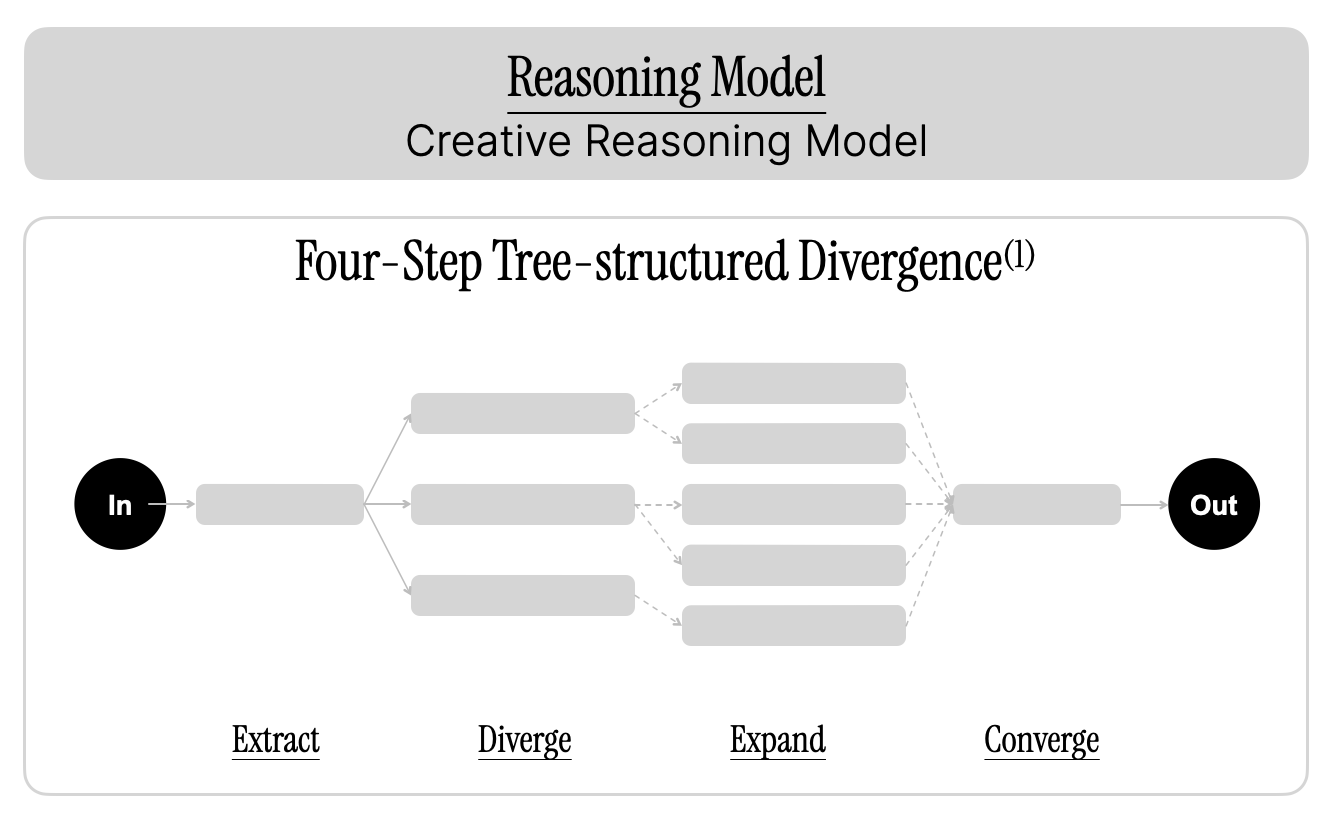
The Creative Reasoning Model is trained to reason the same way. It breaks a brief into sub-problems, unfolds several possibilities for each, often borrowed from other fields, compares and prunes them, and fuses what survives. It treats exploratory value and the discovery of new possibilities as explicit objectives. To our knowledge it is the first divergent, creativity-centered reasoning model.
Divergence does not come from prompting; it has to be in the training data. The model learns from the decision records of real design projects: 10,000 trajectories from more than 180 companies, each annotated by hand from brief to delivery. Each one keeps the ideas that were dropped, who dropped them and why, because judgment is learned from what was rejected as much as from what was chosen. A small model trained to force divergence expanded these seeds to one million trajectories, sampled and checked by practitioners who had run similar projects.
Structure
- Evaluation
- 77% preference in a 2025 blind test: 970 of 1,260 votes by client brand managers and creative directors, comparing Tezign's full system built on Works 01 and 02 with a base model (p < 0.001)
- Developed at
- Tezign, with the Design AI Lab, Tongji University
- Research line
- Creative Reasoning, Design AI Lab
In use